

Basseterre, St. Kitts (Public Infrastructure News) – Following a mid-February announcement that plans were underway for the 2026 iteration of the Energy Unit’s Career Day on March 10, Dr. Bertill Browne, Director of the Energy Unit in the Ministry of Public Infrastructure, Energy, and Utilities, issued an official update last week, indicating that Career Day would be held later in 2026 as the Unit’s resources would now be allocated to the imminent launch of two new energy initiatives.

During the 2026 National Budget Debate in December 2025, Hon. Konris Maynard, Minister of Public Infrastructure, Energy, and Utilities, presented the initiatives to the general public, and indicated then, that they were expected to be launched in January 2026, with the implementation of both likely to occur by April.
Responding to questions about the launch’s delay, Dr. Browne shared that the Energy Unit was actively working behind the scenes to refine the initiatives and associated submissions for the Cabinet.
With the requirement of Cabinet approval now satisfied, the Unit has begun to make definite plans to launch the initiatives either by the end of March or in April.
The first initiative is the Solar Integration for Sustainable Energy Program (SOLARISE). Explaining the program, Minister Maynard said:
“[C]itizens and residents will be incentivized to install rooftop solar systems and be fairly compensated for excess energy returned to the grid through a net billing mechanism.“
The second program is the Decarbonized Roadway Initiative for Vehicle Electrification (DRIVE). Speaking of the program, Minister Maynard said:
“It establishes a clear national vision, it sets manageable objectives for EV adoption, it grounds policy in global best practice and local realities. It provides an actionable roadmap […] for implementation.“
DRIVE symbolizes the Ministry’s progress towards national goals of energy efficiency and decarbonization, by focussing on policies regarding electric vehicles (EVs) and incentives required to facilitate the adoption of EVs as part of a broader plan of sustainability.
Commenting on the initiative, the Minister of Public Infrastructure, Energy & Utilities, and Domestic Transport, Hon. Konris Maynard, said:
“With our upcoming EV initiative to be led by the Ministry’s Energy Unit, we will take a meaningful step toward accelerating the adoption of electric vehicles. This initiative will be designed to make EVs more accessible while advancing our commitment to environmental protection and long-term sustainability for our nation.”
Why Focus on Transportation
In November 2023, Minister Maynard articulated the national perspective to regional colleagues at the 8th Caribbean Sustainable Energy Forum (CSEF) in Jamaica, in a session that focussed on Electrifying the Caribbean – Views on the Roadmap and Strategy.
He stated:
“St. Kitts and Nevis, to me, is probably a model place for us to contemplate the transition to electric vehicles and E-mobility; why? The main one is St. Kitts is 32 miles long.
“An electric vehicle has a range of over 200 miles. So therefore, as I’ve said before, if you buy an electric vehicle, unless you’re not reaching home every night, which you’re supposed to be doing, you can charge your vehicle and never have to use a charging station.
“And I’ve not only said this as the Minister, I have done it, and I decided that I will take the lead. I’ve invested in an electric vehicle. I have a home charger, and obviously, it works well.”
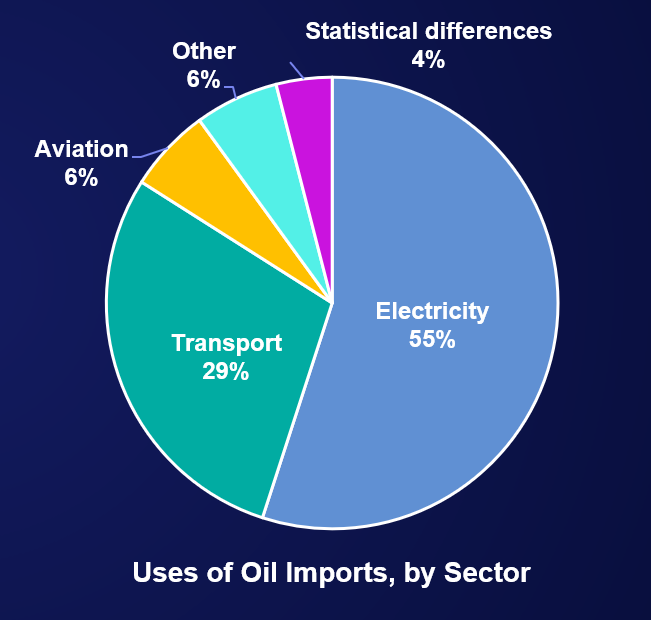
Import data also presents another compelling reason to focus on the transportation sector. According to the Energy Unit, the transportation sector accounts for 29% of fossil fuel imports annually and approximately 30% of national greenhouse gas emissions.
Director of the Energy Unit, Dr. Bertill Browne, explained:
“A sustained reduction in the sector’s reliance on fossil fuels has the potential to significantly advance our national sustainability goals.
“The ministry’s strategic focus on the transportation sector—alongside ongoing efforts to reduce fossil fuel dependence in the electricity sector, which currently accounts for 55% of fossil fuel imports—creates a dual approach to decarbonization that meaningfully increases the likelihood of success.”
Dr. Bertill Browne
Leveraging the Characteristics of a Typical EV-buyer
Historically, EVs have appealed to environmentally conscious drivers who also typically have more disposable income to commit to their purchases because of higher upfront costs usually associated with EVs relative to gasoline or diesel vehicles.
The incentives offered under the DRIVE program, however, are poised to reduce the typical upfront costs associated with EV purchases, making EVs more accessible.
Speaking to his colleagues at CSEF-8, Minister Maynard contextualized important considerations for the implementation of an EV Policy and Action Plan that would help consumers overcome the price barrier. He stated:
“As small territories, we collect a significant amount of taxes from people buying vehicles through duties, for instance. With the price of electric vehicles being as high as they are then, how do you incentivize someone to buy an electric vehicle that is 20 or 30% more than a regular [Internal Combustion Engines (ICE)] vehicle?
“Well, one way is [through] duty concessions. But if our country is collecting 45% duty on ICE vehicles and you’re getting millions of dollars through duty payments – through taxes – how do you tell your Ministry of Finance […]to cut out that revenue? Where do you fill that vacuum that is being created from that? […]These are the kinds of discussions that we’re going to have to have or are having?”
Hon. Konris Maynard
Two and a half years after Minister Maynard’s initial statement on EVs, the ministry is expressly pursuing all viable options to help consumers overcome the price barrier, with the Energy Unit actively engaged in finalizing proposals for concessions.
A Credible Commitment to Explore Concessions
Energy Officer, Denasio Frank, confirmed that the ministry is currently reviewing proposals related to three concessions:
- Revised import duties for EVs
- Contributions to EV infrastructure
- Smart charge bundles that couple rooftop solar PV infrastructure with EV infrastructure

Frank stated:
“Each of these—on their own and together—show the ministry’s real commitment to making renewable transport options more affordable. It’s all part of the bigger push toward a more sustainable future.”
Denasio Frank
A Roadmap to Transition in the Transportation Sector
The EV Transition Plan is a blueprint for the future of sustainability in the transportation sector. Frank explained it as follows:
“The EV Transition Action Plan lays out a clear, actionable roadmap for how we move forward. It focuses on three key areas: scaling up electrification of government fleets, piloting electric buses and taxis to modernize public transport, and establishing charging infrastructure across the country to ensure reliable coverage.”
As plans for the launch continue to develop, visit Public Infrastructure News for the latest information.